The first international students of the Master’s degree in Computer Engineering with a focus on software defended their theses.
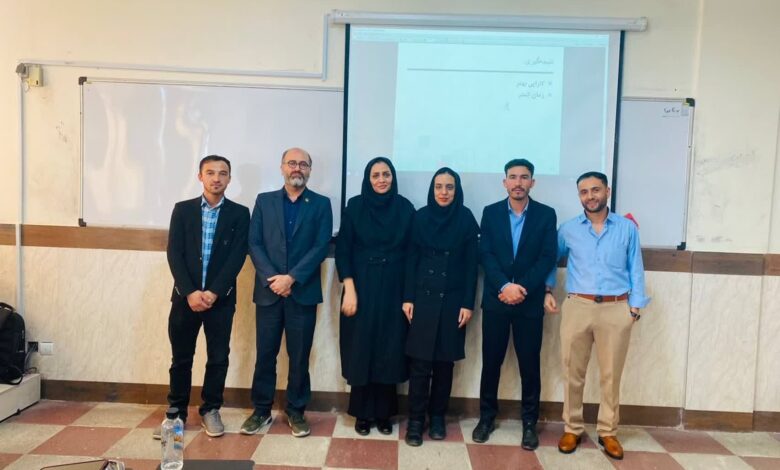
Nematollah Kamali defended his thesis titled “Maximizing the Impact on Social Networks Using Shahin Harris (HHO) Based on Weighted Edge and Near-Side Methods” and Seyed Sadeq Heshami defended his thesis titled “Predicting the Performance of Cosmetic Surgeons Based on Limited Surgical History Data Using Generative Artificial Intelligence” on October 19, 2020, under the guidance of Dr. Azadeh Tabatabaei. The abstract of Mr. Hashemi’s thesis states: Predicting the results of facial aesthetic surgery before surgery can be an innovative approach in the field of medical imaging that plays a vital role in improving surgical planning and its results.
Using advanced deep learning methods, it is possible to provide highly accurate visual representations of surgical outcomes before they are performed and how to care for patients after surgery. This not only increases patient satisfaction, but also helps the surgeon perform the surgery more accurately. These predictive tools actually act as an assistant to surgeons, ultimately reducing postoperative complications and speeding up patient recovery time. In this study, we investigate the combination of advanced generative artificial intelligence techniques along with limited surgical history data to predict cosmetic surgeon performance. Our main goal is to accurately and reliably assess and predict cosmetic surgery outcomes using machine learning models, including transform vision and the latest deep learning approaches, such as generative adversarial networks. To address the challenges of limited training data, we use self-supervised learning and multi-stage learning approaches that help the models learn effectively even from sparse information and data. Furthermore, we use multi-faceted self-supervised learning (adversarial learning, reconstruction learning, and predictive learning) to combine different types of data, which increases the overall intelligence of the system. Our results show that intelligent application of these methods can effectively improve medical decision-making. Finally, studies on the prediction of facial cosmetic surgery indicate that no similar model has been available to predict the outcome of facial cosmetic surgery before surgery.